
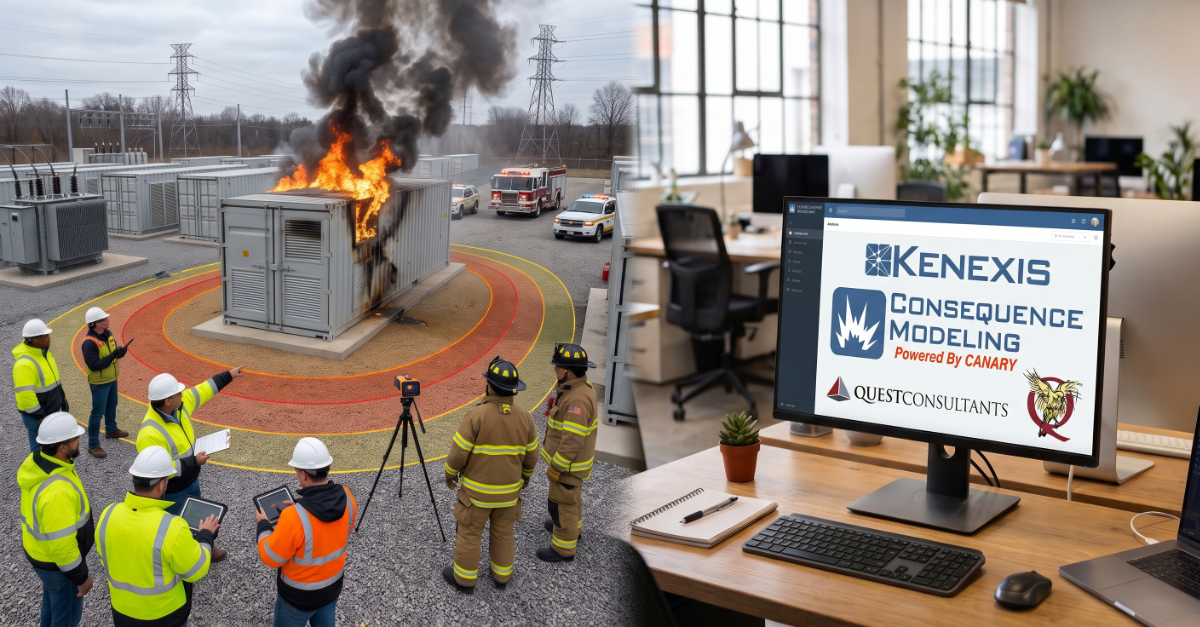
The expanding use of battery energy storage system (BESS) units has received an increasing amount of attention from process safety and fire protection engineers, as well as emergency response professionals. There remains a great deal of uncertainty surrounding the proper mitigation measures and emergency response for BESS units in a thermal runaway event. The 2026 edition of the National Fire Protection Association (NFPA) standard 855, Standard for the Installation of Stationary Energy Storage Systems, was released in late 2025. This standard, first published in 2020, includes a requirement for a hazards mitigation analysis (HMA). The HMA is intended to evaluate single failure modes that affect the reliability and survivability of critical systems during a thermal runaway event, as well as the consequences of such events. Focus is placed on prevention and mitigation, rather than a quantitative understanding of the hazards. While not specifically required, consequence modeling of the hazards associated with thermal runaway are a useful element of an HMA for outdoor applications.
This special presentation by Jeff Marx of Quest® will walk through an evaluation the general methodologies and good practices for evaluating explosion and vapor dispersion hazards with the intent of providing setback distances for emergency response and sensitive exposures. Use of the Kenexis® Consequence Modeling tool will be demonstrated, within the context of BESS hazard modeling. The web-based platform for consequence analysis is powered by the CANARY by Quest® software, a consequence analysis package that has served the petrochemical industry for over 3 decades. CANARY, as well as the Kenexis® Consequence Modeling tool, provide the models to estimate the potential impacts of flammable vapor dispersion, toxic vapor dispersion, and vapor cloud explosion from BESS units. These models are supported by integrated thermodynamics and release modeling to provide the source term information for the hazard models. Use of these models and application of some of the core concepts for BESS modeling will be demonstrated.
Jeff is a Principal Engineer with Quest Consultants in Norman, Oklahoma, USA, and a registered fire protection engineer. He earned his Bachelor’s degree in mechanical engineering from the University of Oklahoma and a Master’s degree in Mechanical Engineering from Georgia Tech.
In his 33 years at Quest, Jeff’s primary responsibilities have been in consequence and risk analysis studies, code compliance studies, and fire protection for the petrochemical industry. This work includes facility siting, building siting studies per API RP 752/753, fire protection, and quantitative risk analysis (QRA) studies for various corporate and regulatory entities.
His work has involved all aspects of the petrochemical system, including pipelines, gas plants, refineries, LPG terminals, hydrogen facilities, and chemical plants. Much of this work has been involved in the LNG industry, including application of varied siting standards for LNG plants, and as a member of the Canadian Standards Association’s Z276 committee, the LNG standard for Canada.
Jeff is also responsible for several portions of the CANARY by Quest consequence analysis software, and has helped to develop, maintain, and apply the CANARY+ risk analysis toolset used at Quest.