
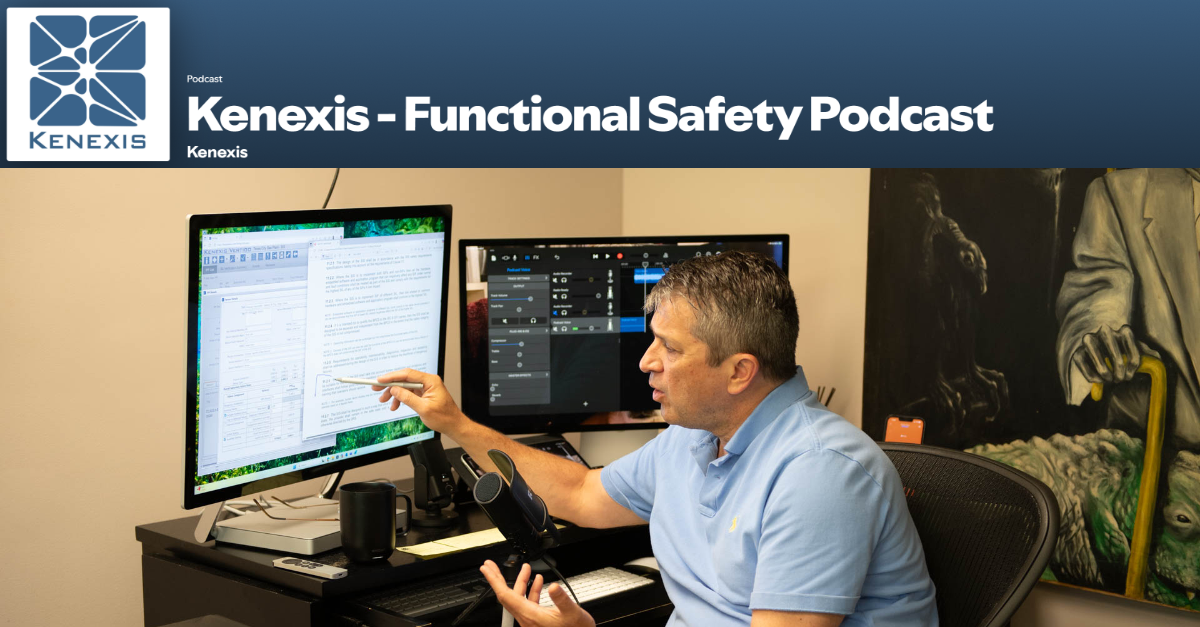
Kenexis Functional Safety Podcast
Spreadsheets don’t save lives—management systems do. In this episode, Ed Marszal makes the case that competency gaps and organizational failures dwarf calculation errors as causes of SIS failure. He walks through Clause 5.1’s objective, the dense requirements of 5.2.1 through 5.2.4, and why the 2016 standard tightened competency documentation far beyond the gut-check permissiveness of 2003. Ed offers practical paths to compliance: downloadable SIS procedure templates from Kenexis, competency matrices tied to roles rather than individuals, and the committee’s intent behind “appropriate to their role.” For engineers building defensible functional safety programs, this is the episode that turns clause numbers into working management systems.
Management of functional safety is the key to a good safety instrumented system.
Please join Ed Marszal, President and CEO of Kenexis, for the latest episode of the inaugural season of our new Kenexis Functional Safety Podcast on Spotify and Apple Podcasts where he discusses the IEC 61511 standard. Clause 5.1 through 5.2.4 is covered in this episode.
As a Principal Engineer (PE) himself with decades of experience in safety instrumented systems, Ed brings a unique perspective to this podcast, having actively contributed to the ISA 84 committee since 1994.
In this inaugural season, Ed will delve into the IEC 61511 standard, examining each word’s significance. He provides detailed insights into the standard’s interpretation and application, complemented by personal stories from his career and committee discussions.
Full Episode Transcript
KENEXIS FUNCTIONAL SAFETY PODCAST — S1E11 TRANSCRIPT (Markdown)
Cleaned & reflowed for web publication and AI crawlability.
The JSON-LD block below is schema.org structured data. If your CMS lets you
add raw HTML to a post, paste it into the page
body — crawlers read it either way). Fill in PLACEHOLDER_EPISODE_PAGE_URL
once the post exists. Everything from the "# Kenexis Functional Safety
Podcast…" heading down is the transcript body — paste it into your post.
–>
"`html
"`
# Kenexis Functional Safety Podcast — Season 1, Episode 11: IEC 61511, Clause 5.1 to 5.2.4 (Management of Functional Safety)
—
## Introduction and Episode Overview
Management of functional safety is the key to a good safety instrumented system. All of the calculations that we're going to do really have very little bearing on your overall safety because human factors are the things that are really going to drive safety. And all those are dealt with not in the calculations, but in the management.
Welcome to the Kenexis Functional Safety Podcast. I'm your host, Ed Marszal, President and CEO of Kenexis. Kenexis is a technical safety consultancy that helps chemical process industry companies to analyze risk and design engineered safeguards like safety instrumented systems and fire and gas detection systems. Kenexis also provides the industry-leading suite of software tools, including our best-in-class Vertigo software for SIS safety lifecycle management.
In this first season of the podcast, we are going to focus on the IEC 61511 standard, doing a deep dive into the standard, including more depth of information on what the standard means and how to apply it, brought to life with personal war stories and behind-the-scenes discussions of the committee members as we develop the standard in ISA 84 and IEC SC 65.
Before we start, a little disclaimer. I will be providing my opinion on technical and engineering topics. This information is provided on a best-effort basis and is of a general nature. The information presented in this podcast might not be applicable to your specific application. It is the obligation of every engineer to thoroughly analyze any system that they are designing and not blindly rely on any general advice presented in this podcast.
Don't slog through definitions. We're now going to get into the actual meat of the standard, the requirements, the things you need to do.
And the first topic in those things you need to do, we're going to cover management of functional safety. This is where you do all of your planning, all of your resource development, define your organization. It's all of the administrative systems, all the management systems that allow you to have a safety instrumented system that's going to work. And this is going to be the key to ensure that those human errors don't result in safety instrumented system failures. So let's dig on into it.
## Clause 5 Objective: Management of Functional Safety
So clause 5 is management of functional safety. And clause 5.1, as you're going to see, we always start out in the .1 clause being the objective. And all that stuff I told you in the last episode about normative versus informative, the objectives are always actually informative. There's no way that you can verify that the objective is being achieved, oddly enough.
So the requirements start in clause 5.2, but what is the objective 5.1? It is the objective of the requirements of clause 5 is to identify the management activities that are necessary to ensure the functional safety objectives are met. So we are identifying the management activities.
And there are a lot of management activities. There are activities related to planning. There are activities related to defining your organization. activities related to identifying your resources. And that's where we're going to talk a lot about competency.
Competency is a big issue. And honestly, it's probably one of the primary reasons that safety instrumented systems fail due to the competency of the people that are designing, implementing, or maintaining them. So beyond that, though, we're also going to get into some of the key activities that will ensure that human failures don't impact a safety instrumented system.
And one of the key activities to catch human failures is going to be the functional safety assessment, which is going to be described in detail in this clause, along with auditing, is another thing that's going to be described in this clause in quite a bit of detail. Beyond that, we're also going to rely on verification, which falls into clause 7, and then validation, which is all the way back out in clause 15.
Okay, there is a note 1 to clause 5.1, the objective, and that note is Clause 5 is solely aimed at the achievement and maintenance of functional safety of SIS and is separate and distinct from general health and safety measures necessary for the achievement of safety in the workplace.
So we're calling out in this note that there's a distinction between functional safety, which is a technical safety activity, and then the old slips, trips, and falls, hard hat safety, industrial hygiene. Those are different activities that we're not going to be talking about when we talk about functional safety. So functional safety is the term that's used in the IEC 61511 standard of the 1508 series in general. It is a specific type of technical safety that's related to the functioning of safety equipment.
## Clause 5.2.1: Policy, Strategy, and Communication
Okay, 5.2 is requirements. So let's delve into the requirements. There are quite a few of them related to management. So 5.2.1 is general. And it states, The policy and strategy for achieving functional safety shall be identified together with the methods for evaluating their achievement and shall be communicated within the organization.
So you need to have a policy for achieving functional safety. For most of you, that's going to be your corporate SIS standard. Or you might have a site SIS standard if your corporation doesn't apply that or doesn't provide that for you. In a lot of cases, there will be a corporate standard, but you'll also have a site standard to kind of fill in the blanks and provide a little bit more additional information on top of what the corporate standard says.
So that's the policy. And the policy is going to document the strategy. But the strategy is how you're going to achieve what your policy says. So there's going to have to be management systems. There's going to need to be software tools that are going to allow you to achieve all of these objectives. And on top of that, so you're going to have your policy and your strategy. You're going to identify that. And then you're going to have the methods for evaluating their achievement. So it's not enough just to tell people these are the steps that are going to be executed.
These are the people that are going to be executing these steps. These are the tools that are going to be used for the execution of those steps. You need to also have methods for evaluating whether or not you've achieved those objectives.
Little hint, we're going to be talking about that a little bit later on in this management section because that is the functional safety assessment and that is the audit.
Now, having all this information, having all these systems, still not enough. Because we need to communicate all of this within the organization. So one sentence is packed with a lot of work.
So what did this one sentence require you to do? Well, number one, it required you to develop that corporate and or site standard that is going to define what work needs to be done. Who needs to do it? How are we going to verify that we achieve those requirements through functional safety and auditing? And now that communication means you need to get the message out to everyone in your organization, specifically people who have tasks that they're responsible for that are going to be necessary to achieving functional safety.
So some sort of training mechanism to communicate all this out to the organization.
So kind of starting out, what are some of the things that you're going to need to do? And what are the mechanisms for getting that done? Well, number one, you're going to need to have an SIS procedure or a functional safety procedure.
If you don't have one, I've got good news for you. It's going to be available for you on the Kenexis website. So if you need a starting point for your procedure, go to the Kenexis website, www.kenexis.com. And once you get there, you're going to look under the menu that is called Tools. So under the tools, there's going to be a list of things that you can download, including spreadsheets. So these resources are available, spreadsheets, Word documents. One of those is going to be an SIS template procedure that you're going to be able to use for your organization.
All you're going to have to do is customize it to meet your specific needs. And it's going to have all of the requirements that we're going to see in 5.2.2, 5.2.3. The balance of clause 5 or 5.2, and there's a lot of it. All of that gets covered in this template standard. So keep that in mind as I'm going through these requirements that you're going to be able to download a starting point that you're going to be able to customize for your organization. No charge from your good friends at Kenexis.
All right.
And then communication. So what I would recommend for communication, and we're going to come back to this when we're talking about training, when we're talking about competency, is that you need to provide training. You need to verify the training was received. You're going to need to track training. We'll talk about all that when we get to competency. And Kenexis has an online training class that we call SIS Overview and Awareness that you could use as a starting point for communicating this type of information to your organization.
And you might want to add additional information on top of that that is specific to your organization, which, of course, if you're using the Premier Kenexis integrated safety suite of tools, there is that learning management system built in where you can create your own training module that lays out the specifics for your organization. But that type of online training system, the whole learning management system, is excellent for achieving the requirements related to training that are in the IEC 61511 standard.
## Clause 5.2.2.1: Assigning Roles and Activities
Okay. That's Clause 5.2.1, general information. One sentence. Next up is an entire section. So 5.2.2 is a section that's entitled Organization and Resources. So it's more than just one sentence. There are many clauses, and I'm going to hit these clauses one at a time.
Actually, I might even hit them one bullet point at a time because some of these clauses break down into individual bullet points, and they cover most of an entire page of the standard. So if you're reading along as we go through this, you'll see that in 5.2.2.2.
But let's start with 5.2.2.1. It says persons, departments, organizations, or other units which are responsible for carrying out and reviewing each of the SIS safety life cycle phases shall be identified and informed of the responsibilities assigned to them. Okay.
So you need to figure out what activities happen in the safety life cycle. You need to assign someone with responsibility for those activities, and then you need to let them know that they're responsible for carrying out those activities.
How do we do this? Well, it just so happens we already did it for you in the SIS procedure. So part of your functional safety management procedure or your SIS procedure for your organization is probably going to include kind of a customized flow chart or list, a series of activities that you're going to perform in order to fulfill the requirements of the SIS safety life cycle.
And for each one of those activities, what you're going to need to do is assign it to someone.
Now, normally, it doesn't make sense to assign activities to a person because in organizations, well, people go on vacation. People retire. Sometimes there's too much work for just one person. So instead of assigning to a person, you're going to assign to a role like SIS engineer or SIS SME, subject matter expert. It might be you're assigning things to a PHA facilitator or to the PSM coordinator and so on. You really want to avoid names.
And then once in your standard, you've assigned each one of these activities to a role, you'll also want to, in other management systems, assign human beings to those roles. So that's something that's going to be better tracked in your human resources department through your human resources software and systems where people have job titles, job descriptions, and roles that they are assigned to.
So that's kind of the process for the assignment. So, for instance, you might assign planning for a layer of protection analysis to your PSM coordinator, and you might assign SIL verification calculations to your SIS subject matter expert. All of that is going to happen in your functional safety management document or procedure that you're using, your SIS procedure.
Okay. Okay. Once again, we've got a template that you could use. Go to our website and download it. Okay.
So once we've assigned all this information, we need to let people know. Normally, there are a lot of different ways that this can be carried out. But typically, every person has someone that they report to. And so their manager, the manager that they report to as part of the human resources process essentially needs to tell them what their job responsibilities are. Usually, that's documented. You can always point to the SIS safety lifecycle procedure to let people know what their responsibilities are and how they're supposed to carry out those responsibilities.
Also, you know, you're probably also going to want to include this in a project management tracking system or other databases where work gets assigned. So detailed work like installation of equipment or doing testing, you're probably going to assign that through a computerized maintenance management system.
Whereas execution of projects is typically handled through a project management system. So every time a project comes up, you're going to break it down into its individual tasks, put those tasks on the project lifecycle, assign them to people. And then hopefully, your system has the capability to send people emails and let them know that things are on schedule or behind or so on. So that's typically how responsibilities are going to be assigned to people at the macro level, but then also down into the individual project level. All of that is described in Clause 5.221.
## Clause 5.2.2.2: Competency Requirements for SIS Activities
Next up is going to be Clause 5.2.2.2.2. I know these numbers get long. I apologize for that, but, well, it's the numbering system. What are you going to do? Okay. In Clause 5.2.2.2.2, it says, Persons, departments, or organizations involved in SIS, safety lifecycle activities, shall be competent to carry out the activities for which they are accountable. Okay.
This is something that is critical. and as I go through the rest of this clause, I'm going to talk about a lot of things and I'm going to give you some suggestions for how you're going to need to do this because although it is just one sentence, it is a very loaded sentence and there are a lot of expectations and high bars to cross for achievement of this. As a matter of fact, some of the wording was tightened up since the 2003 version of the standard because it was a little bit too loose.
So if you look at the first sentence in the clause, it just says people, departments, organizations that are going to carry out activities for the SIS lifecycle need to be competent. Now, the devil, as always, is in the details.
What does that mean? How do I do it? Well, in the last version of the standard, that could have been as easy as, well, I'm the manager and I know my employees and my gut tells me that this employee is capable of carrying out that activity so they are competent. That might have been okay in 2003. It is not okay today. There is a lot more that goes into it in terms of being able to verify and document that competency. So what is it and how do I know that this person meets those requirements? More on that coming up.
Okay, so the second sentence in this clause states, the following items shall be addressed and documented when considering the competence of persons, departments, organizations, or other units involved in SIS safety lifecycle activities. So what you're going to see next is a bullet list of the things that need to be addressed and documented. Documented. I'm going to come back to where that documentation is in just a second. Considering the competence of people, departments, and organizations.
So after this, you're going to get a bullet list or a lettered list, A through I, of some of the things that you need to consider when you're talking about competency.
And let me just hit these one at a time. I'm going to blow through them. I'm not going to spend a lot of time on them because they're things that should be pretty obvious to you. So A, engineering, knowledge, training, and experience with regards to the process, the equipment under control. B, engineering, knowledge, training, and experience appropriate to the technology used. So if you're using a relay-based system versus a PLC-based system, you need to understand how a PLC works versus how a relay works.
C, engineering, engineering, knowledge, training, and experience appropriate to the sensors and the final elements that are being used in the safety instrumented system. D, safety engineering, knowledge. So for existence, the ability to perform a process hazards analysis. E, knowledge of the legal and regulatory functional safety requirements. So what laws, what regulations apply to your safety instrumented systems? And how do you know whether those laws and regulations are being complied with?
F, adequate management and leadership skills appropriate to their role in the SIS safety life cycle activities. Now there is the first time that a key phrase shows up. Appropriate to their role in the SIS safety life cycle activities. I'm going to come back to that again when we get to the end of the list here. Okay, item G, understanding of the potential consequence of an event. So what is the event that the SIS is intended to protect against? H, the SIL of the safety instrumented system. And I, the novelty and the complexity of the application and the technology.
So that's our bullet list of the things that you need to consider when you're judging the competence of people that are going to be performing SIS safety life cycle activities.
Now that's a pretty long comprehensive list and it kind of makes sense. Those are definitely the things that you should think about. But does everybody need to know everything?
No. And that's what the extra statement in bullet point F alludes to. Appropriate to their role in SIS safety life cycle activities. So if you're just a technician whose job it is to go out in the field and test pressure transmitters to make sure that they're working, you don't necessarily need to have a great deal of experience in the process, the chemical process that's occurring. You need to have some. You need to understand the hazards of the process. But you don't need to perform a mass balance on it. Also, the technology.
Well, if you're using a relay-based system, you should know how to design a relay-based system. But if you have a relay-based system, you really don't need to know how PLC-based logic solver systems work. So every one of these bullet items for what you need to know has that caveat of, well, I need to think about what am I actually going to be responsible for based on what my application is. So what still am I trying to achieve with my process? What is the novelty and complexity of my application? And those things that I'm trying to do with my safety instrumented system.
## Documenting and Managing Competency
So now, it says that we need to address and document this. So somewhere, I need to have written down or some sort of tangible, visible, viewable document that tells me, what did I consider when I was determining who was competent? Turns out that that is going to show up in that functional safety procedure. Once again, if you want to see a good example, go to the Kenexis website and download our procedure. That will tell you what you need to know. Okay.
So looking at all that information, we need to know that people are competent in that stuff. We need to document who needs to be competent in what. And what you're going to see, I'm going to go read through Clause 5.2.2.3. And then I'm going to kind of point back to the way that we handle these requirements and our standards.
Because we're going to tie safety lifecycle activities to people, to roles. And then we're going to set competency requirements for a role. So we're going to say, okay, if your role is SIS sensor technician, let's say that's a role, then there's going to be competency requirements for people that are expected to perform that role. That's how we're going to tie things together. Okay.
But before we do that, let me go in and read the requirement for Clause 5.2.2.3. And what it says is that a procedure shall be in place to manage the competence of all those involved in the SIS lifecycle.
So now, okay, so back in Clause 5.2.2.2, we said that we're going to address and document. And well, where are we going to do that? It's going to be in our procedure for managing competence. Now, do we need a separate dedicated procedure for managing competence? No. Well, maybe you do. Maybe you might want to have that in your HR procedures. But most people are going to document this in their functional safety standard in their SIS procedure.
When they go through the process of listing out what tasks need to be performed and what roles need to perform those tasks, a logical next step is to say for each role, what is required for someone to be competent? That would be for this role, we want to see this educational background in terms of degrees and certificates from external organizations or external training.
There might be a list of training classes or training activities that can be taken externally or internally. And then there might also be physical tests that they need to take or physical activities that someone needs to watch them perform to verify that they're competent. So all of those bullet items, those activities or requirements or degrees or training that's required to say that somebody is competent, those need to be documented in a procedure. And lo and behold, that SIS procedure is a good place to do that.
Please take a look at our template procedure as a good reference for how you might want to do this.
Okay.
The next sentence in Clause 5223 says, So there's a key phrase I want you to think about and that key phrase is document the competence.
So now it's not enough for the department manager to say, Oh, I know that guy. He's been working with me for a long time. He's good at his job. I consider him to be competent. No, we need to document that we achieved whatever those competency requirements are. And then there's going to be some periodic assessment to verify that the people that are performing the work are competent to do it.
We're not going to get to it in this session. But in Clause 5, we're going to be talking about auditing. And one of the key aspects of auditing is looking at people who are doing work, checking their records to make sure that they're competent to do that work, which means that there needs to be records that they are competent. So how do I recommend doing that?
Well, there's a lot of different ways to do it. But ultimately, you need to think about the correlation between people, roles, and competency criteria. So you could take a person. And for each person, that person has one or more roles. And each of those roles is going to have a bullet list of competency activities.
You can put these on a matrix. So on each row, you have a person. And then in columns, you can have competency activities. And those competency activities might be, do they have an engineering degree, maybe for some of the SIS engineering activities? Or do they have a technician degree if there is a technician activity? You might look at certification. So are they an ISA 84 expert or an ISA 84 SIS fundamental specialist? Do they have that certificate if they're performing SIL verification calculations?
Or you might want an ISA certified technician if they're performing technician activities related to the SIS. And you might have internal training classes like SIS overview and awareness or company XYZ safety lifecycle planning.
Those are all the training classes.
So have some sort of matrix. You're going to correlate the person with the activity. You can also track things like status and date. Now, how would you do this? Well, you know, you could do it in an Excel spreadsheet. Nothing wrong with that. But of course, at Kenexis, we recommend the gold standard tool. The Kenexis Integrated Safety Suite has the Process Safety Training Center, which has a learning management system where you could put in all of your employees. You can put in all of the Kenexis training classes. You could put in all you can add in your own training classes.
And that matrix is going to allow you to assign people to training, verify that the training is completed. And then, you know, constantly be able to keep track of status. It also allows you to cancel people's training, force them to take refresher training. It's a whole good management system.
And when audit time comes, you simply go into KISS, Kenexis Integrated Safety Suite, go into the Process Safety Training Center, show them the matrix, and that will tell everyone what competency people have been assigned, what they have been achieved, and make sure that they are up to what their requirements are. So, lots of tools here available for Kenexis to do that competency management, including actually some of the training classes are available to you through KISS.
Okay. And again, the key there is you need to document the competence. So, whether you're going to use the Process Safety Training Center or you're going to just do this in Excel spreadsheet, you need to have documentation of those competency factors, competency achievements being made by everyone who has been assigned SIS Lifecycle Activities. Okay.
## Clause 5.2.3: Risk Evaluation and Risk Management
Let's go on to Clause 5.2.3, which is Risk Evaluation and Risk Management. So, managing risks is kind of a management activities, but we're going to punt.
All we're going to say in Clause 5.3.2 is that hazards shall be identified, risks shall be evaluated, and the necessary risk reduction determined as defined in Clause 8. So, yes, we're going to talk about risk evaluation, we're going to talk about risk management, but that's going to begin in Clause 8 when we're doing things on a project-by-project basis, whereas right now we're still early trying to just set up our management systems before we even think about doing our first project.
There is a note to Clause 5.2.3, and it states it may be beneficial to consider potential capital losses for economic reasons when you're doing your risk analysis and your risk assessment. Yes, but boy, you know, I don't want to get too far off topic. A lot of people have regretted including financial losses when they're picking SIL targets. I don't recommend that, but we'll get into that a little bit more when we get into Clause 8 and we're talking about risk assessment.
## Clause 5.2.4: Safety Planning Requirements
All right, the last clause that I want to talk about today is going to be 5.2.4, which is safety planning. And in reality, I already talked about this probably as much as you need to know when we were in Clause 5.2.1.
So, you need to put together a plan. So, let me go back to Clause 5.2.1. It says the people who are responsible for carrying out activities shall be identified and their responsibilities assigned to them. Well, how are you going to do that? You're going to do that through safety planning. Okay, so what is safety planning?
The clause says safety planning shall take place to define the activities that are required to be carried out along with the persons, departments, organizations, or other units responsible to carry out these activities. So, basically, what this clause is telling you is that you need to do what you said you were required to do in Clause 5.2.1. Okay, yes. What does this look like? It looks like maybe a modified safety life cycle. Maybe it's just a kind of flow chart or a list of tasks that happen on a project-by-project basis.
And who's going to do those tasks based on role, not based on individuals' names.
The next sentence says, this planning shall be updated as necessary throughout the entire SIS safety life cycle. See Clause 6. When we get to Clause 6, that's going to be where the SIS safety life cycle is laid out. Okay, so throughout the entire SIS safety life cycle and carried out to a detailed activity level, commensurate with the role of the individual or organization is performing in the SIS safety life cycle.
So, basically, we need some sort of plan, and that plan generally is converted into a document that lists out what are the tasks, who's going to perform the tasks, and any required instructions in the level of detail that's commensurate for how they're going to perform those tasks.
So, how is this safety planning done? How is it documented? Well, I already told you. You're going to write an SIS life cycle plan or an SIS plan or a functional safety plan that's going to apply to your organization at a corporate level or at a site level.
So, that's kind of reinforced by the note to the clause, and the note to the clause says, the safety planning can be incorporated in one of the following. One, a section of the quality plan entitled SIS safety life cycle plan. Okay, so ISO, IEC, they're all big on ISO 9000, so if you want to have SIS life cycle plan as something that's part of your quality program, you are free to do that.
As a matter of fact, that's kind of what Kenexis does. We are ISO 9000 certified. Go through a recertification every other year. Go through an audit, external third-party audit every year. So, our SIS safety life cycle activities, everything that we do in terms of SIS engineering is done in accordance with our ISO 9000 procedures.
Or, you might want to create a separate document that's entitled SIS safety life cycle plan. If you want one of those, well, that's what you can download from the Kenexis website. We make that available in the tools section of our website that you can use as a starting point.
A lot of you people that are listening to this already have a document. So, please go to your, if you don't know where it is, go talk to your supervisor or someone in your organization and get that document so that you can read up how this has been done for your organization.
Or, it may be several documents which may include company procedures or working practices.
And that's actually what we do at Kenexis. So, at Kenexis, there is an overall quality plan. And overall, in that overall quality plan, there is an order fulfillment plan by which we execute our services. And then that order fulfillment plan is going to refer to several different procedures depending on what life cycle activities we are performing. So, for instance, we have a procedure for performing HAZOPs, a procedure for performing LOPA, a procedure for performing SIL verifications, and so on. And you know what? Those documents are also available to you.
I don't know off the top of my head whether we have them on the website right now, but I will make sure to put them there because they are so valuable.
Of your safety planning resides. It's going to be your SIS procedure. Your SIS procedure is probably going to also refer to a lot of other procedures for how to do the individual tasks. So, that is your safety planning. And we at Kenexis are more than willing to help you if you need some assistance doing that safety planning. And again, hit that website, download some examples. All right.
## Episode Close and Next Episode Preview
With that, that is all I have for you today. In the next episode, we're going to continue on with our safety planning. So, we're still in Clause 5.2, Organization and Resources. We're going to start next week with implementation and monitoring. But that's all I have for you today. See you next time.
## Kenexis Vertigo Software Overview
Now that you've heard some insights on technical safety, functional safety, and the IEC 61511 standard, let me tell you a little bit more about how to easily and effectively implement the safety lifecycle using the Kenexis Integrated Safety Suite and our SIS Safety Lifecycle Management Tool, Vertigo. Vertigo is a comprehensive tool set for performing assessment calculations, documenting, and maintaining the design of safety instrumented systems.
Analysis begins with importing or synchronizing a list of safety instrumented functions with their definitions and associated performance targets from our open PHA tool for HAZOP and LOPA documentation. Each safety function can then be analyzed by performing a SIL verification calculation, complete with a collection of tools for optimizing designs and a database of thousands of potential instruments to define failure rates and diagnostic coverage capabilities.
After the SIL verification calculations are defined, you can build an SRS by automatically generating a cause and effect diagram from the SIF definitions and other defined instruments. Each SIS instrument will include a customizable data sheet and general requirements that are applicable to the SIS as a whole and can be entered individually or even bulk imported from customizable libraries. After the design phase, you can even use Vertigo to track and document testing throughout the entire life of the facility.
Kenexis Vertigo is the most integrated, easy-to-use enterprise tool for allowing the development of SIS design basis information more efficiently and effectively than any other software application. Thank you.