
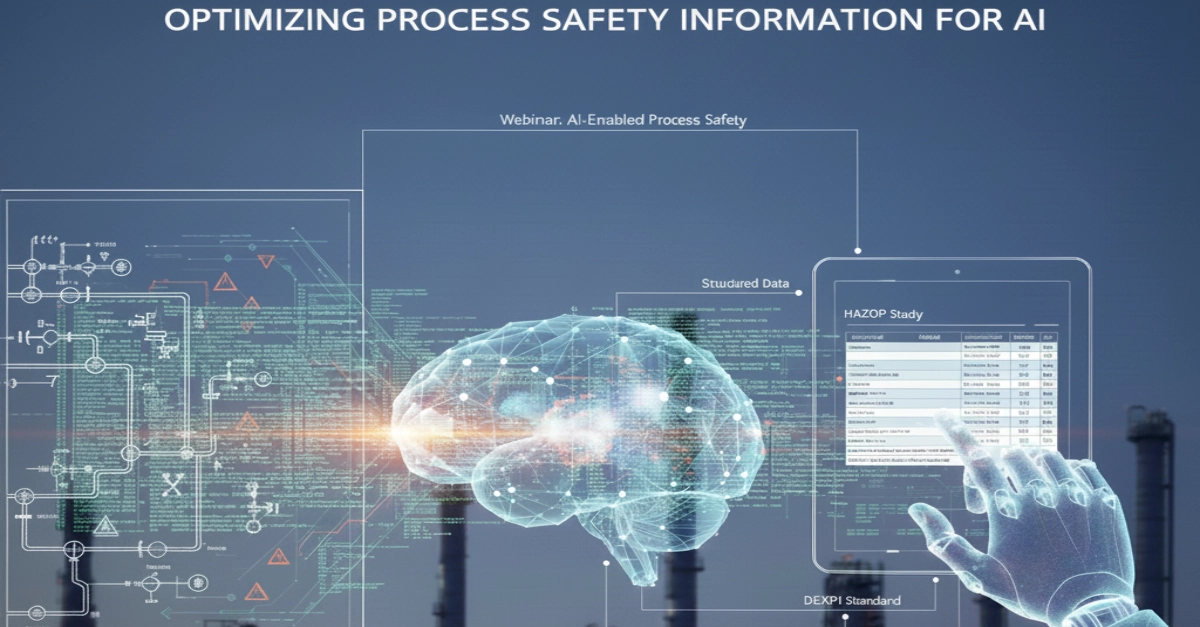
Optimizing Process Safety Information for AI
Artificial intelligence (AI) continues to expand its impact across all engineering disciplines, including process safety engineering. As organizations look to leverage AI more effectively, one critical requirement is often overlooked: the way process safety information (PSI) is structured and presented to these tools.
To deliver meaningful and reliable results, AI systems must be provided with complete and well-organized PSI. Traditionally, PSI relies heavily on drawings—reflecting the long-held belief that “a picture is worth a thousand words.” However, large language models fundamentally operate on language, not images. This creates a challenge: visual information must be translated into words and stored in a standardized, structured format that AI systems can understand and efficiently retrieve.
Doing so enables the use of vector databases and retrieval augmented generation (RAG), allowing AI to access large volumes of PSI accurately and at scale. Without this structure, much of the value of AI in process safety applications remains unrealized.
During this webinar we will explore how PSI is used by human engineers—and, by extension, how it should be organized for AI to support engineering tasks such as hazards and operability (HAZOP) studies. It offers practical recommendations for storing and presenting PSI to AI tools, including the use of standards such as DEXPI for piping and instrumentation diagram (P&ID) data structures. We will also highlight ongoing research and findings, providing insight into the future of AI-enabled process safety.
As AI becomes an increasingly powerful partner in engineering, rethinking how we prepare and manage PSI will be essential to unlocking its full potential.